
Larry Wolfe built his reputation in the 1970s as a hands-on mattress maker. He cut fabric, sewed edges, and learned web programming so he could sell his family's latex beds directly to consumers. Today his company, Sleep EZ, continues to ship customizable latex mattresses from its factory in Arizona.
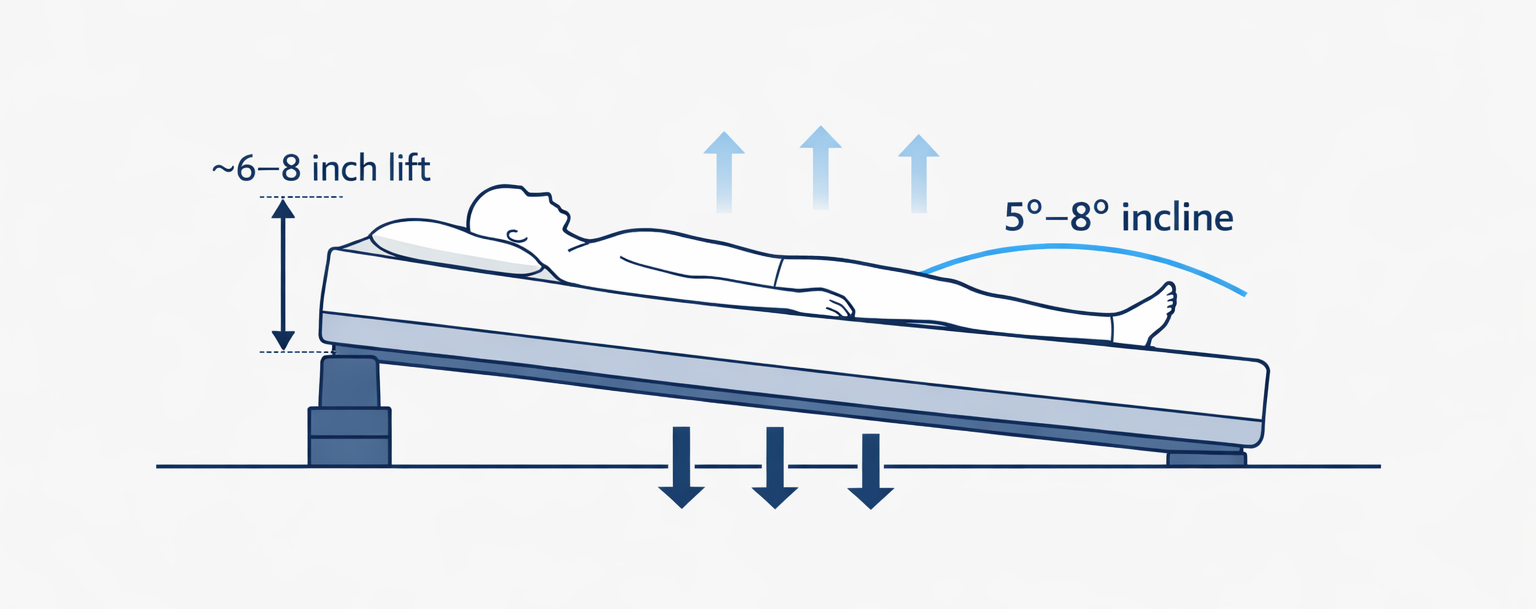
Wolfe's latest passion, however, is not a material but an angle. After hearing the late engineer Andrew K. Fletcher talk about inclined bed therapy five years ago, Wolfe began to sleep on a tilted base. The experience changed his perspective on bedding and health. He believes that raising the entire bed by around six to eight inches — a slope of roughly five degrees — helps gravity move blood and lymph through the body.
At seven inches you're a five-degree incline, and that is the optimal where most people get their benefit.
— Larry Wolfe, founder of Sleep EZ
Wolfe now wants to transform what he calls "millions" of grassroots users into a global community. To do that he built InclineSleep.com, a website that gathers testimonials, research, and retailer listings. He refuses to charge manufacturers to be listed; instead, he wants to drive customers to showrooms that carry incline-capable bases and raise awareness inside the industry.
In one anecdote, he recalled asking executives from a major adjustable-bed company about inclined sleep.
Not one of them knew a thing about it.
— Larry Wolfe, founder of Sleep EZ
Wolfe sees the movement as a crusade rather than a product launch. He hopes to turn happy outliers into a mainstream force and says he will reinvest any profits from base sales into educational outreach.
What the Science Says
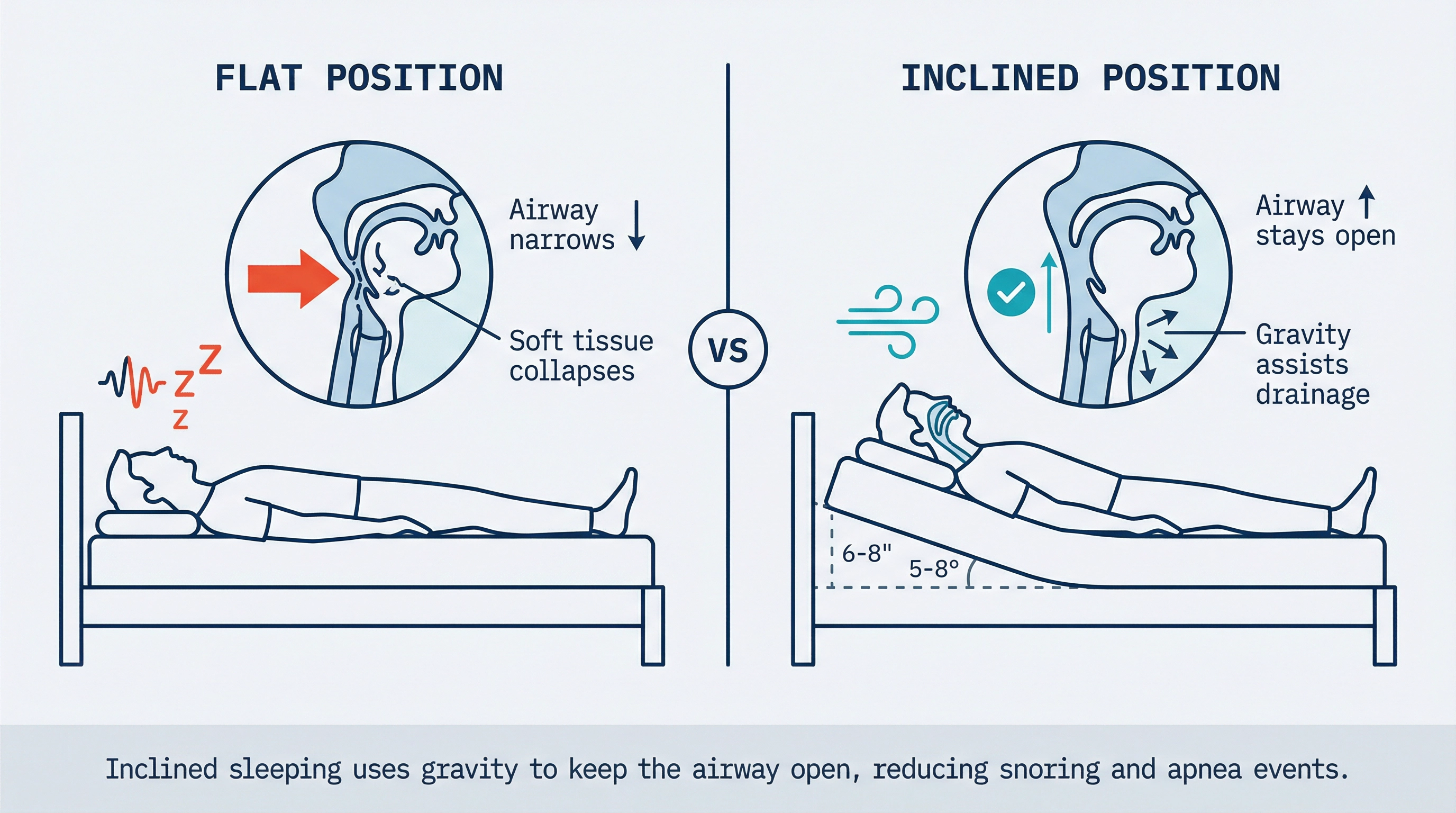
The research behind incline sleep is still emerging, but a handful of peer-reviewed studies point in the same direction. A 2022 study published in JMIR Formative Research followed 25 habitual snorers over eight weeks. When participants switched from sleeping flat to sleeping at a 12-degree incline, snoring dropped by 7%, nighttime awakenings fell by 4%, and time in deep sleep increased by 5%. The authors concluded that a modest incline can meaningfully improve sleep quality — without any medication or device.
Breathing and airway collapse
A separate 2022 study in the Journal of Clinical Medicine looked specifically at positional sleep apnea. Researchers found that elevating the head and trunk at a 30-degree angle reduced upper-airway collapses and improved breathing events through the night — the same mechanism Wolfe describes when he talks about gravity keeping the airway open.
The benefits extend beyond the airway. A 2023 meta-analysis in the Journal of Neuroscience Nursing reviewed eight randomized controlled trials on patients with acquired brain injuries. Elevating the head of the bed by 30 to 45 degrees lowered intracranial pressure by an average of 2.4 mm Hg — a meaningful reduction achieved through positioning alone.
How the brain cleans itself during sleep
A 2015 study in the Journal of Neuroscience found that body posture during sleep affects how efficiently the brain clears waste proteins, including amyloid-β, which is associated with Alzheimer's disease. While the study did not test incline directly, it reinforced the idea that gravity and posture shape what happens in the brain overnight.
Wolfe is careful not to overclaim. He acknowledges that the research is still early and that more robust trials are needed. But the pattern across these studies — better breathing, lower pressure, cleaner brain — aligns with what he hears from the community he has built at InclineSleep.com.
Gravity helps the blood circulate. The lymph fluids in your brain have to be flowing too — and a gentle tilt can reduce pillow height and ease neck strain.
— Larry Wolfe, founder of Sleep EZ
Industry Response: Beyond Head-Up, Foot-Up
Traditional adjustable bases raise the head and legs independently. Wolfe argues that these "lifestyle" positions work for reading or watching television but break the spinal line for side sleepers. A true full-body incline tilts the entire sleep surface so that gravity works along the body's long axis, and the sleeper can roll from back to side without losing the angle.
Several manufacturers are beginning to embrace this approach. Wolfe has catalogued at least ten on the InclineSleep.com manufacturer map:
- BedTech & Glideaway ↗
- Full-tilt capabilities & accessories
- Leggett & Platt ↗
- Sleep+Motion Line
- Symphony Sleep ↗
- Elevation Kit — ES200, ES500 & ES600
BedTech and Glideaway — which supplies components to Symphony Sleep — were among the first to add full-tilt capabilities or accessories to their lines. Their early adoption helped establish that the category had commercial legs before larger players moved in.
Leggett & Platt recently introduced its Sleep+Motion line. The patented design supports the entire body and offers limitless sleeping positions — signaling recognition that many buyers want more than head-up or foot-up options.
Symphony Sleep offers an Elevation Kit that adds a third motor to its ES200, ES500, and ES600 bases. The kit can tilt the entire base up to 12.5°, supports 600 lb per side, and uses a quick-connect system for easy installation.
A Crusade Rooted in Craftsmanship
Wolfe's passion for incline sleep reflects his broader philosophy about bedding: take care of customers and let the product speak for itself. In his view, the biggest obstacle to adoption is simply awareness. He remembers a bedding executive confessing ignorance about incline and sees the anecdote as a sign that the industry needs education.
To that end, he plans to publish newsletters, host ambassadors, and continue to share testimonials through InclineSleep.com.
The biggest benefit is better airflow and increased circulation, and your heart doesn't have to work as hard because gravity takes the blood down.
— Larry Wolfe, founder of Sleep EZ
Incline sleep is not a cure-all. Research on conditions such as Alzheimer's prevention remains preliminary, and scientists caution that more robust trials are needed. Yet the combination of personal experience, early data, and growing manufacturer support gives Wolfe confidence that the movement will grow.
By tilting the bed instead of stacking pillows, he believes people can elevate both their mattress and their health — perhaps giving a literal rise to the next big trend in sleep.
Key Takeaways
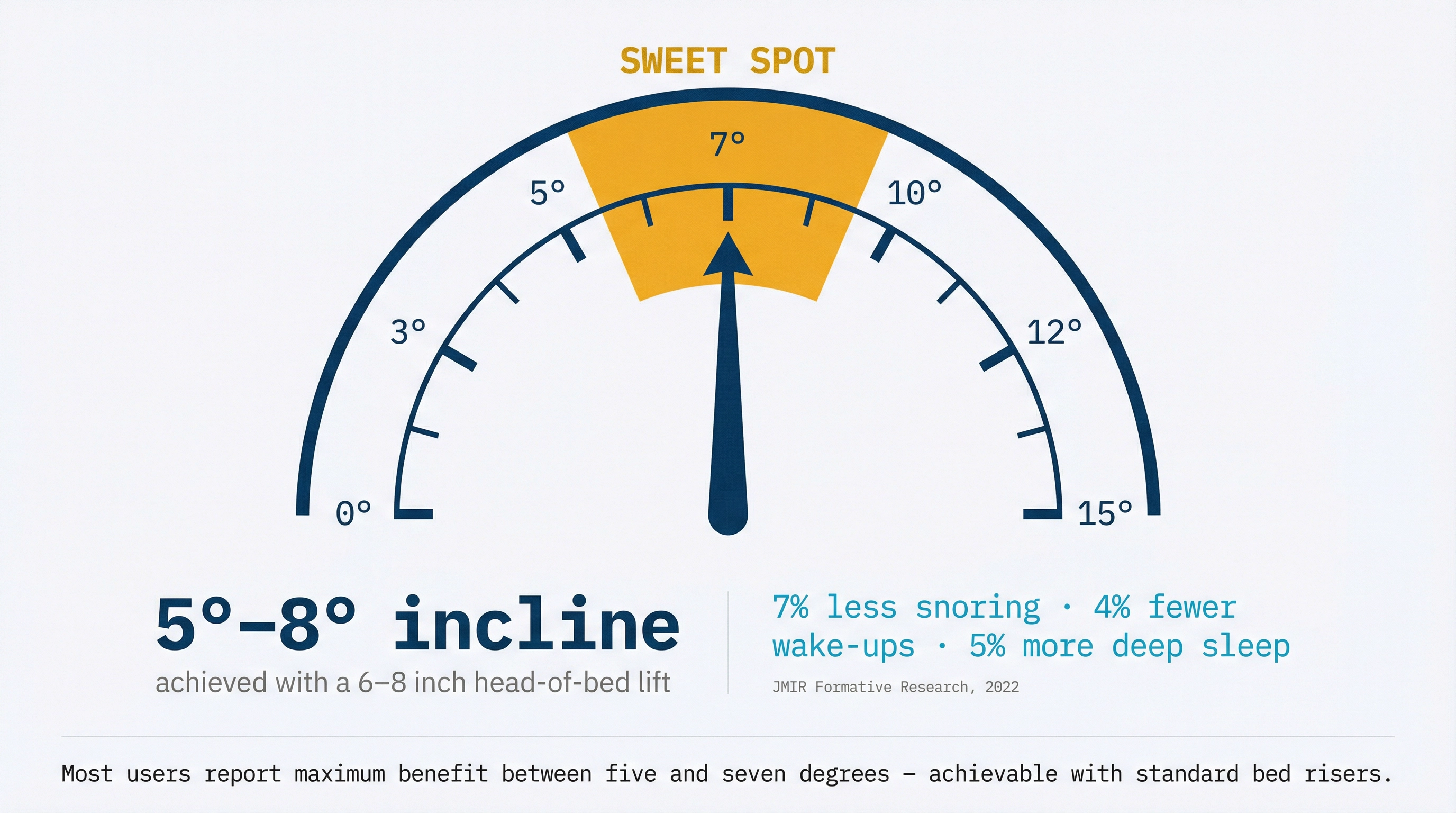
Seven inches is the sweet spot.
A 5-degree (7-inch) full-body incline is the angle most users report as optimal. It is enough to engage gravity without making the bed feel like a ramp.
The science backs better breathing.
Multiple peer-reviewed studies support improvements in snoring, sleep apnea, and intracranial pressure from head-of-bed elevation — without drugs or devices.
True incline is not adjustable-base head-up.
Traditional adjustable bases raise the head and foot independently. A true incline tilts the entire sleep surface along the body's long axis, preserving spinal alignment for side sleepers.
Manufacturers are already moving.
Symphony Sleep, Leggett & Platt, BedTech, and Glideaway are among the brands already offering full-tilt solutions. Wolfe has catalogued at least ten on his manufacturer map.
InclineSleep.com is free for retailers.
Larry Wolfe's InclineSleep.com is a manufacturer-neutral resource for retailers and consumers. Listings are free — Wolfe's goal is awareness, not revenue.

About Larry Wolfe
Founder, Sleep EZ
Wolfe has been in the bedding industry since the 1970s and is the creator of InclineSleep.com, a community hub for inclined bed therapy research, testimonials, and retailer listings.
Peer-Reviewed Research Sources
- JMIR Formative Research (2022) — Sleeping in an Inclined Position to Reduce Snoring and Improve Sleep: In-home Product Intervention Study ↗
- Journal of Clinical Medicine (2022) — Head-Of-Bed Elevation (HOBE) for Improving Positional Obstructive Sleep Apnea (POSA): An Experimental Study ↗
- Journal of Neuroscience Nursing (2023) — A Meta-analysis of the Clinical Efficacy of the Head-of-Bed Elevation for Patients With Acquired Brain Injury ↗
★ Sleep Summit 2025 Series
Continue Reading the Series

Industry Trends
Reading the Economic Room
Dr. Chris Kuehl breaks down the K-shaped recovery, tariff inflation, and what mattress retailers need to know heading into 2026.

Retail Strategy
The Four Wheels That Keep Your Store on the Road
Jason Goodman's Traffic, Transactions, Ticket, and Margin framework — and why most retailers are unknowingly driving on a flat.

Industry Trends
The Science of Sleep Is Your Competitive Advantage
Dr. Elie Gottlieb explains how clinical sleep knowledge can transform the way mattress retailers sell.
Share this article
#TheFAM #MattressIndustry #InclineSleep #SleepHealth #Innovation